
Some of the links in this post may be affiliate links, which means I may receive a commission if you click on them and make a purchase. However, this comes at no additional cost to you, and I only recommend products and services that I truly believe in. Please note that I am not responsible for the quality, accuracy, timeliness, reliability, or any other aspect of the products and services sold on external websites linked to this post.
As health-conscious individuals, we are constantly striving to nourish our bodies and optimize our well-being. We pay close attention to what we put into our bodies, seeking out natural remedies and supplements to support our health. However, one aspect that often goes overlooked is the presence of heavy metals in our environment and their potential impact on our health.
You’ll often hear me mention how a certain situation repelled me into the natural-minded mother that I am today. See, when I first started to make the transition, it took years. And in those years, big events or realizations began to take place that got the wheels turning more and more. Heavy metals are one of them. While my children had safe levels of lead, unfortunately, that seems to be the only metal that is regularly tested. I won’t lie; I wasn’t educated on heavy metals. I had read a post about the signs and symptoms of heavy metals and had this unnerving feeling that I needed to detox my littles. And the drastic change that I watched happen to my boys was unexpected.
In short, my oldest went from being nearly nonverbal to engaging in conversation with extended family members, and my secondborn’s eczema began to disappear! The products we used specifically support the gut, liver, and pulling of heavy metals. And I will say I always have these on hand because, as you’ll read soon, every single human being is exposed to heavy metals each day. That is why regular maintenance is vital for overall health!
What’s the big deal?
Heavy metals, such as lead, mercury, arsenic, and cadmium, are toxic elements that can accumulate in our bodies over time, leading to a wide range of health issues. These toxic metals can be found in various sources, including contaminated water, tap water, air pollution, foods, dental fillings, and even beauty and household products. Understanding how heavy metals can enter our bodies is crucial in taking steps to mitigate their harmful effects.
One common way heavy metals enter our bodies is through ingesting contaminated foods such as fish and seafood, especially those high on the food chain, which may contain high levels of mercury due to bioaccumulation. Similarly, certain foods, such as rice, may contain arsenic due to soil contamination.
Another route of heavy metal exposure is inhalation. Air pollution from industrial activities, car emissions, coal-fired power plants, and more can release heavy metals into the atmosphere, which can then be inhaled into our lungs. Occupational exposure to heavy metals in industries such as mining, construction, and battery manufacturing can also be a significant source of heavy metal exposure. Additionally, dental fillings made of amalgam, which contains mercury, can release small amounts of mercury vapor that can be inhaled and absorbed by the body.
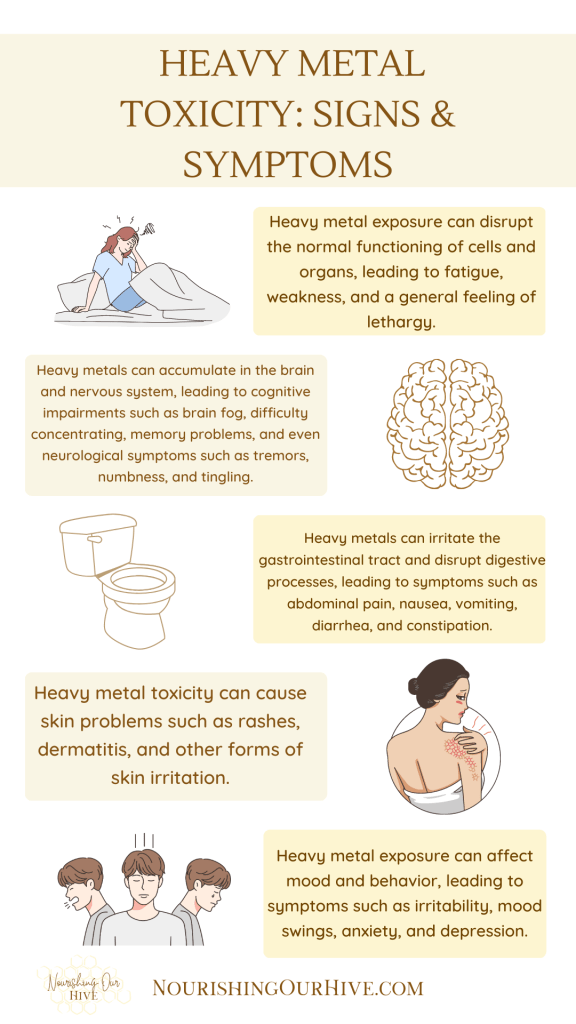
Possible symptoms
- Fatigue and weakness: Heavy metal exposure can disrupt the normal functioning of cells and organs, leading to fatigue, weakness, and a general feeling of lethargy.
- Cognitive and neurological symptoms: Heavy metals can accumulate in the brain and nervous system, leading to cognitive impairments such as brain fog, difficulty concentrating, memory problems, and even neurological symptoms such as tremors, numbness, and tingling.
- Gastrointestinal issues: Heavy metals can irritate the gastrointestinal tract and disrupt digestive processes, leading to symptoms such as abdominal pain, nausea, vomiting, diarrhea, and constipation.
- Skin issues: Heavy metal toxicity can cause skin problems such as rashes, dermatitis, and other forms of skin irritation.
- Mood and behavioral changes: Heavy metal exposure can affect mood and behavior, leading to symptoms such as irritability, mood swings, anxiety, and depression.
- Joint and muscle pain: Heavy metals can accumulate in joints and muscles, leading to symptoms such as joint pain, muscle aches, and stiffness.
- Respiratory issues: Inhalation of heavy metal particles or fumes can irritate the respiratory system and lead to symptoms such as coughing, wheezing, and shortness of breath.
It’s important to note that heavy metal toxicity can be subtle and may not always present with specific symptoms. Additionally, the severity and type of symptoms can vary depending on the type of heavy metal, the duration and level of exposure, and individual susceptibility. If you suspect heavy metal toxicity, it’s essential to consult with a qualified holistic healthcare professional for proper evaluation, diagnosis, and treatment.
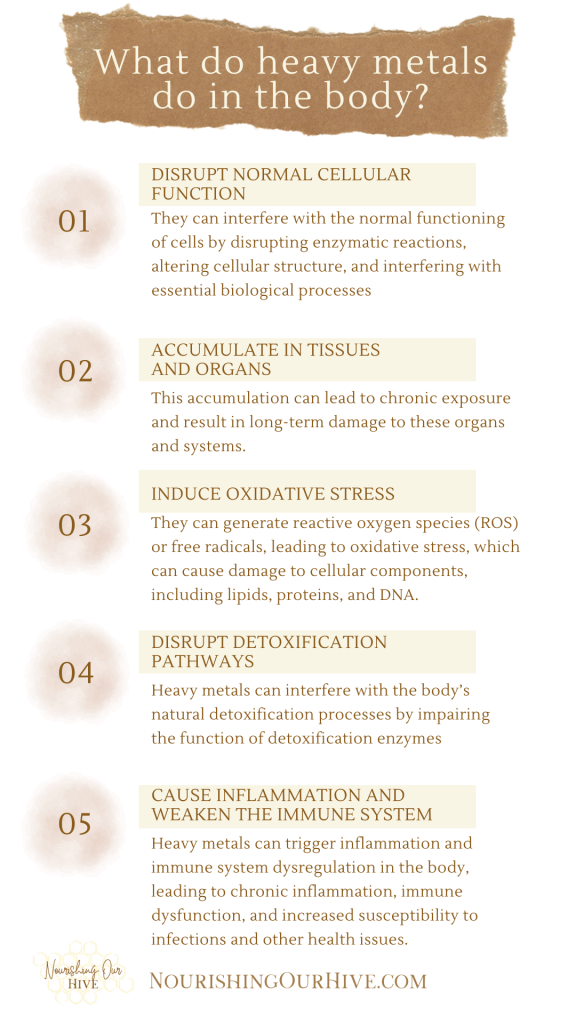
What do heavy metals do in the human body?
- Disrupt normal cellular function: Heavy metals can interfere with the normal functioning of cells by disrupting enzymatic reactions, altering cellular structure, and interfering with essential biological processes. This can lead to impaired cellular function and overall dysfunction of organs and systems.
- Accumulate in tissues and organs: Heavy metals can accumulate in various tissues and organs of the body, such as the liver, kidneys, brain, bones, and nervous system, over time. This accumulation can lead to chronic exposure and result in long-term damage to these organs and systems.
- Induce oxidative stress: Heavy metals can generate reactive oxygen species (ROS) or free radicals, leading to oxidative stress, which can cause damage to cellular components, including lipids, proteins, and DNA. Oxidative stress can trigger inflammation, cellular damage, and impaired organ function.
- Disrupt detoxification pathways: Heavy metals can interfere with the body’s natural detoxification processes by impairing the function of detoxification enzymes, such as glutathione-S-transferase, which plays a crucial role in eliminating toxins from the body. This can further contribute to the accumulation of heavy metals in the body.
- Bind to proteins and enzymes: Heavy metals can bind to proteins and enzymes in the body, disrupting their structure and function. This can lead to altered enzymatic activity, impaired protein function, and disrupted cellular processes.
- Interfere with neurotransmitters: Some heavy metals, such as mercury and lead, can interfere with the normal functioning of neurotransmitters, which are essential for communication between nerve cells. This can lead to neurological symptoms such as tremors, seizures, and cognitive impairments.
- Cause inflammation and weaken the immune system: Heavy metals can trigger inflammation and immune system dysregulation in the body, leading to chronic inflammation, immune dysfunction, and increased susceptibility to infections and other health issues.
What can we do?
So, how can we naturally support our bodies in detoxifying heavy metals and minimizing their impact on our health? Fortunately, nature provides us with various options to aid in this process. If there’s one thing I love, it’s the power of whole foods.
One powerful natural detoxifier is chlorella, a type of freshwater algae known for its ability to bind to heavy metals and facilitate their removal from the body. Chlorella has a unique cell wall structure that allows it to bind to heavy metals like mercury, lead, and cadmium in the digestive tract, preventing their absorption into the bloodstream. Chlorella also contains essential nutrients like chlorophyll, vitamins, and minerals, which can support overall health and well-being. Hello, little powerhouse!
Another herb that has been traditionally used for detoxifying heavy metals is Oregon grape root. Oregon grape root contains a compound called berberine, which has been shown to have strong antioxidant and detoxifying properties. Berberine has the ability to bind to heavy metals and promote their elimination from the body through urine and feces. Additionally, Oregon grape root can also support liver function, which plays a crucial role in the body’s detoxification processes. The perfect all-in-one detox herb! When detoxing, supporting your detox pathways (a big one being your liver!) is crucial.
One of the products I mentioned earlier contains both Chlorella and Oregon Grape Root alongside other herbs that help support our bodies and immune system while detoxing. You can check it out here! This product is safe for ages 1 and up.
In addition to chlorella and Oregon grape root, there are several other herbs and supplements that can support the body’s detox pathways and aid in heavy metal detoxification. These include cilantro, milk thistle, garlic, and N-acetyl cysteine (NAC). Cilantro, commonly used as an herb in cooking, has been shown to have chelating properties, helping to mobilize and eliminate heavy metals from the body. Milk thistle is known for its liver-protective properties, which can support the liver in processing and eliminating heavy metals. Garlic, a well-known culinary herb, has antioxidant properties that can help neutralize heavy metals and promote their elimination. NAC is a powerful antioxidant that can increase the production of glutathione, a critical antioxidant in the body that plays a role in heavy metal detoxification.
If you have suspicions that you may be dealing with heavy metal overload, I recommend reaching out to your preferred holistic provider for further guidance.
What about the children?!
Head on over to this post for more information on children and heavy metals.
Resources
- “A Review on Chlorella- A Nutraceutical Algae” – International Journal of Pharmacy and Pharmaceutical Sciences (https://innovareacademics.in/journals/index.php/ijpps/article/view/18929/12413): This scientific article provides an in-depth review of chlorella, including its nutritional value, potential health benefits, and its role in detoxification, supported by scientific research.
- “Berberine: An Alternative Approach for the Treatment of Metabolic Syndrome” – Biomedicine & Pharmacotherapy (https://www.ncbi.nlm.nih.gov/pmc/articles/PMC5852681/): This scientific article discusses the potential health benefits of berberine, including its antioxidant and detoxifying properties, supported by scientific studies.
- “The Role of Glutathione in Detoxification” – Environmental Health Perspectives (https://www.ncbi.nlm.nih.gov/pmc/articles/PMC1242206/): This scientific article provides an overview of the role of glutathione, a critical antioxidant in the body, in detoxification processes, supported by scientific evidence.
- “Toxic Metal Exposure as a Cause of Parkinsonian Symptoms” – Environmental Health Perspectives (https://www.ncbi.nlm.nih.gov/pmc/articles/PMC1637782/): This scientific article discusses the potential health risks of heavy metal exposure, including their impact on neurological health, supported by scientific research.
- Agency for Toxic Substances and Disease Registry (ATSDR) – Heavy Metals: The ATSDR is a federal public health agency in the United States that provides comprehensive information on toxic substances, including heavy metals. Their website offers in-depth information on various heavy metals, their sources, health effects, exposure pathways, and recommendations for exposure prevention and management. (Website: https://www.atsdr.cdc.gov/toxfaqs/index.asp)
- Environmental Protection Agency (EPA) – Heavy Metals: The EPA provides information on heavy metals, including their sources, environmental impact, and regulations related to heavy metal contamination. Their website offers resources on heavy metals such as lead, mercury, arsenic, and cadmium, and their potential health risks. (Website: https://www.epa.gov/chemical-research/heavy-metals)
- World Health Organization (WHO) – Heavy Metals: The WHO offers authoritative information on heavy metals, including their sources, health effects, exposure assessment, and risk management. Their website provides global guidelines and recommendations on heavy metal exposure limits and mitigation strategies. (Website: https://www.who.int/occupational_health/topics/metals/en/)
 Victoria Naturally