

As you may already know, if you’re not new here, I’m only 5 years strong into this natural living journey. I grew up on conventional medicine and OTC meds for ailments. I’m grateful to have the option of conventional medicine if there were to ever be an emergency (though being in America, it would cost me my soul to pay for the bill later.) So while it’s nice to have, I believe preventative measures are extremely important for good health.
So, while it’s good to have these options, they don’t come without risks. In a sense, nearly everything on Earth has a risk, but if you can avoid it and use something safer, why not choose the latter? Over-the-counter (OTC) drugs like ibuprofen, acetaminophen, and allergy medications are readily available at your local drugstore, and it’s easy to assume they are safe for use. After all, they are sold without a prescription and are designed to treat common ailments like headaches, fever, and allergies. However, it’s important to be aware of their potential risks, particularly when taken in high doses or over a long period of time.
Here are some of the most commonly used medications and the dangers associated:
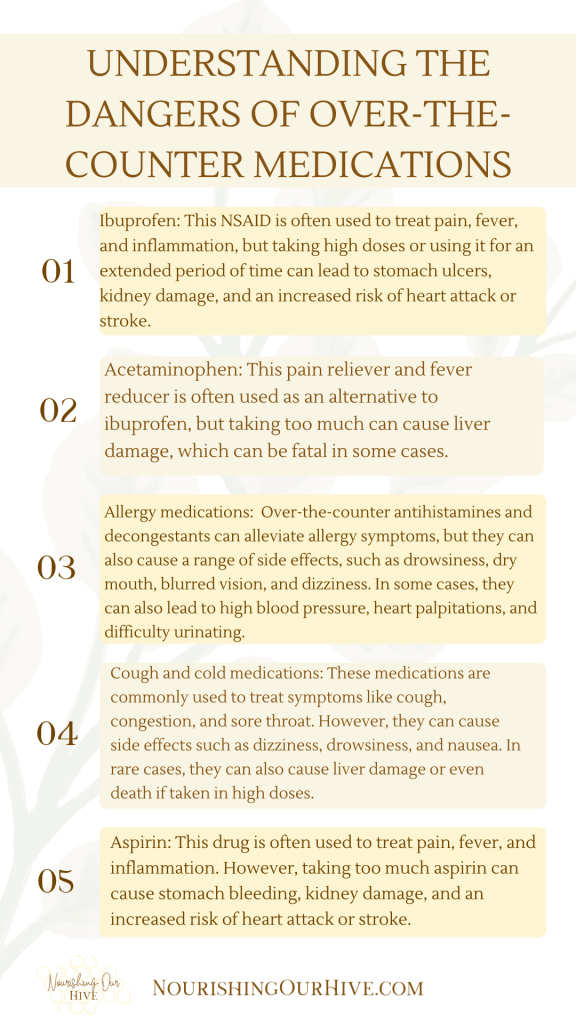
- Ibuprofen: This NSAID is often used to treat pain, fever, and inflammation, but taking high doses or using it for an extended period of time can lead to stomach ulcers, kidney damage, and an increased risk of heart attack or stroke.
- Acetaminophen: This pain reliever and fever reducer is often used as an alternative to ibuprofen, but taking too much can cause liver damage, which can be fatal in some cases.
- Allergy medications: Over-the-counter antihistamines and decongestants can alleviate allergy symptoms, but they can also cause a range of side effects, such as drowsiness, dry mouth, blurred vision, and dizziness. In some cases, they can also lead to high blood pressure, heart palpitations, and difficulty urinating.
- Cough and cold medications: These medications are commonly used to treat symptoms like cough, congestion, and sore throat. However, they can cause side effects such as dizziness, drowsiness, and nausea. In rare cases, they can also cause liver damage or even death if taken in high doses.
- Aspirin: This drug is often used to treat pain, fever, and inflammation. However, taking too much aspirin can cause stomach bleeding, kidney damage, and an increased risk of heart attack or stroke.
In conclusion, over-the-counter medications can be effective in minimizing symptoms of common ailments, but they can also come with serious risks. This is one of the many reasons I’ve phased out of conventional medicine for routine care and use and now use natural remedies for everything we have faced in the past 5 years. I must say, I am thankful we haven’t run into any medical issues that couldn’t be handled at home. I know this isn’t the case for many Americans these days. As always, do what works for you and your family! If you want to learn more about natural remedies, follow Nourishing Our Hive! You can also dive into it in this post.
Resources:
- “Acetaminophen toxicity in children” by Dart, R.C. and Bailey, E. in Advances in Pediatrics, 2014: https://pubmed.ncbi.nlm.nih.gov/25267025/
- “NSAID use and the risk of gastrointestinal damage: a systematic review and meta-analysis of observational studies” by Lanas, A. and Scarpignato, C. in Drugs, 2020: https://pubmed.ncbi.nlm.nih.gov/31950281/
- “Antihistamine-induced cognitive impairment: a systematic review and meta-analysis” by Liu, J. et al. in Frontiers in Neurology, 2021: https://pubmed.ncbi.nlm.nih.gov/33897413/
- “The Risks of Over-the-Counter Pain Relievers” by Harvard Health Publishing: https://www.health.harvard.edu/pain/the-risks-of-over-the-counter-pain-relievers
- “FDA Drug Safety Communication: FDA strengthens warning that non-aspirin nonsteroidal anti-inflammatory drugs (NSAIDs) can cause heart attacks or strokes” by the U.S. Food and Drug Administration: https://www.fda.gov/drugs/drug-safety-and-availability/fda-drug-safety-communication-fda-strengthens-warning-non-aspirin-nonsteroidal-anti-inflammatory
- “Acetaminophen: Use Only as Directed” by the U.S. Food and Drug Administration: https://www.fda.gov/drugs/drug-safety-and-availability/acetaminophen-use-only-directed
- “Are Allergy Medications Safe? Potential Side Effects of Antihistamines and Decongestants” by Cleveland Clinic: https://health.clevelandclinic.org/are-allergy-medications-safe-potential-side-effects-of-antihistamines-and-decongestants/
- “The Hidden Dangers of Acetaminophen” by Consumer Reports: https://www.consumerreports.org/drug-safety/the-hidden-dangers-of-acetaminophen/
 Victoria Naturally